One Flew Over the Cuckoo's Nest
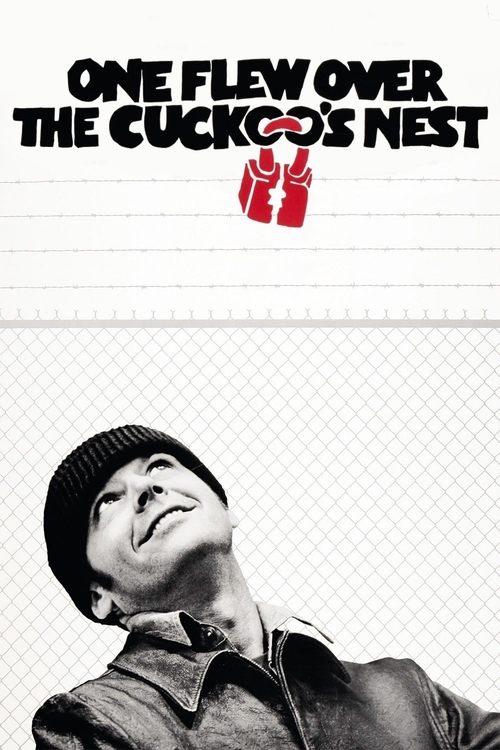
A petty criminal fakes insanity to serve his sentence in a mental ward rather than prison. He soon finds himself as a leader to the other patients—and an enemy to the cruel, domineering nurse who runs the ward.
Trailers & Videos 6
4K Restoration - Official UK Trailer
BFI Trailer
Original Theatrical Trailer

50th Anniversary Spot

45th Anniversary Event
Quentin Tarantino on 1975 Movies
Cast
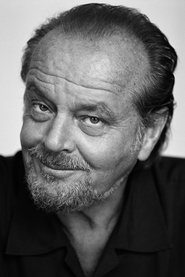
Jack Nicholson
Randle Patrick McMur...
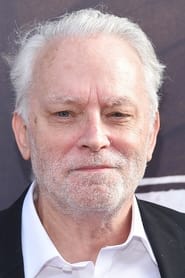
Brad Dourif
Billy Bibbit

Louise Fletcher
Nurse Mildred Ratche...
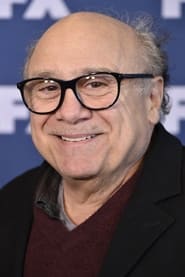
Danny DeVito
Martini
William Redfield
Dale Harding
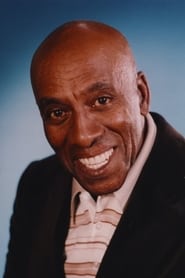
Scatman Crothers
Orderly Turkle
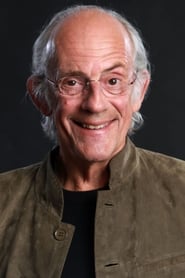
Christopher Lloyd
Max Taber

Will Sampson
Chief Bromden
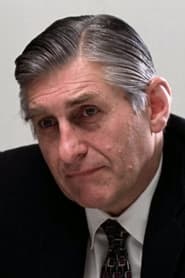
Dean R. Brooks
Dr. John Spivey
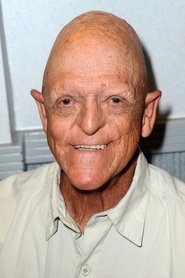
Michael Berryman
Ellis
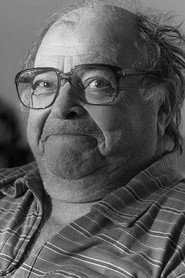
Sydney Lassick
Charlie Cheswick
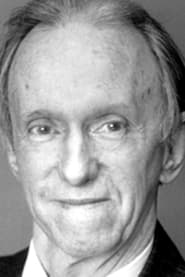
William Duell
Jim Sefelt
Ratings & Reviews
No community reviews yet. Be the first to share your thoughts!
TMDB Reviews
Charles Dance
TMDB9 years ago
Subject to the silliest of internet theories
There are a lot of movie theories but the silliest of all is this nonsense that is all over the internet claiming that the Chief killed the unresponsive McMurphy because he thought McMurphy was ignoring him.
These idiots claim the Chief did not notice the scars on McMurphy's head and simply thought the unresponsive McMurphy was ignoring him - so the Chief kills him in a fit of rage. Ridiculous.
The Chief killed McMurphy as an act of kindness. Chief was releasing McMurphy - a once spirited man now reduced to a vegetable thanks to the control freak, Nurse Wretched.
This classic movie still holds up after all these years and is a compelling story of blossoming friendships in a lunatic asylum. Nicholson shines in his best performance and is ably supported by Christopher Lloyd, Brad Dourif and Danny DeVito.

6 years ago
The spirit of freedom vs. the spirit of legal-ism
Set in the early 60s, the story involves R.P. McMurphy (Jack Nicholson) and his arrival at a mental institution in Salem, Oregon (where the film was shot). He plays the "mental illness" card to get out of prison time, thinking it'll be a piece of cake, but he's wrong, very wrong. Everything appears well at the hospital and Nurse Ratched (Louise Fletcher) seems to be a benevolent overseer of McMurphy's ward, but there are sinister things going on beneath the surface.
"One Flew Over the Cuckoo's Nest" (1975) is a film you'll appreciate more as you mature. I saw it when I was younger and, while I thought it was good, I didn't 'get' a lot of the insights the film conveys.
The movie criticizes the way institutions deal with mental illnesses. Their "therapy" is futile and only makes the patients dependent on the institution itself, thereby creating its need for existence (often at the taxpayer's expense). McMurphy is a threat to the establishment and therefore must be "dealt with."
A lot of people criticize the film by suggesting that Nurse Ratched "isn't that bad" or that "she was only trying to do her job", etc. I had the same reaction the first couple of times I saw it. This reveals an aspect of the film's brilliance: Ratched's malevolence is so subtle that the filmmakers allow the possibility for complete misinterpretation. Yes, from an administrative point of view, she seemingly does a good job, she's authoritarian without being sadistic, and she cares for the residents as long as they follow the rules (more on this below). Yet she is demonic as a robotized arm of a dehumanizing system. She maintains the residents in a state of oblivion and marginalization; they are deprived of their dignity because the system sees them as subhuman.
The filmmakers and Fletcher (not to mention the author of the book, Ken Kesey) make Nurse Ratched a more effective antagonist by showing restraint. Compare her to, say...

5 years ago
One Flew Over The Cuckoo's Nest tells the story of a criminal, Randle Patrick McMurphy (Jack Nicholson), who pleads insanity in the attempt to get a more lenient sentence. Sent to a mental hospital, he livens up the otherwise monotonous lives of the patients, much to the ire of the strict head nurse, Mildred Ratched (Louise Fletcher).
One Flew Over The Cuckoo's Nest clean swept the Oscars in 1976, taking home the five biggest prizes as only the second film to do so since It Happened One Night.
In reality, it is an extremely frustrating film. Pitched as a "man against the system", McMurphy is clearly written to be chaotic and bring some colour to the otherwise black and white world of the hospital. Meanwhile, Ratched is the oppressive villain sticking regimentally to routine despite the suffering of the patients.
In actuality, the opposite appears true. While McMurphy is disruptive, he often comes across as a bully, coercing the patients against their will. Even as he gains some of their trust, he continues to manipulate until he has a majority behind him. Ratched on the other hand is the voice of reason. While the medical practices are undeniably oppressive by modern standards, she remains cool, calm and collected at all times when dealing with her patients.
That being said, Nicholson does give a career defining performance, fully deserving of his Academy Award. It is often his body language or subtle facial expressions that betray the mischief of McMurphy, and these human qualities cannot be expressed in a script. He switches from the chaos and disorder of a profanity-ridden baseball commentary to the benign friendship of some of his fellow interns with consummate professionalism.
He leads an all-star cast including both Danny DeVito and Christopher Lloyd, but the other standout is debutant Brad Dourif as the stuttering and immature Billy Bibbit. And, whenever the film veers towards bedlam, it is Louise Fletcher - who reportedly took on the role...

CinemaSerf
TMDB1 year ago
“McMurphy” (Jack Nicholson) is a veteran with an attitude who has pled insanity to escape his latest court appearance on a charge of statutory rape. He is sent to an evaluation hospital where they are to decide just what, if anything, is wrong with him. His smart-assed confidence endears him to some of his fellow inmates, especially the impressionable “Billy” (Brad Dourif) but also earns him the instant enmity of the chief nurse “Ratched” (Louise Fletcher) who is used to ruling with a psychological rod of iron augmented by pils, pills and more pills. Initially, “Mac” is simply concerned with his own predicament, but as he witnesses the regime that treats these people with indifference, disdain and little affection, he starts to become a little more invested in their future’s. When he manages to orchestrate a wheeze to get the men out on the water for some fishing, then the battle lines are truly drawn - but who is going to emerge victorious? Nicholson is great here as his character evolves before our eyes from a cocky and arrogant one but it is Fletcher who really steals the show and that’s with remarkably little dialogue just a powerful degree of sheer on-screen malevolence. Ken Kesey’s original novel shines quite a potent light on the frankly quite brutal treatment of patients with mental illnesses, even when some of these individuals are volunteers who think this treatment might actually lead to some sort of “cure”; and also at the attitudes of the State that is all to frequently out of sight, out of mind. Milos Forman has paced this tautly and there’s plenty of double-edged humour as a war of words becomes much more one of attrition. I can’t say I loved the conclusion but maybe that’s a testament to the efforts of both ensuring that I cared, liked and loathed as this enthralling and distasteful drama offers a toxic review of what passes for institutional civilisation.